The Belarusian region has been brought to fame by many individuals nurtured on the Belarusian-Russian border. Let us take a look at Veliž. Now it is a small district center in the neighboring Smolensk region of Belarus. It entered history due to many circumstances and twists of fate…
The Veliž Uprising of 1918 and the Veliž Case—a court trial that lasted from 1821 to 1835—are well-known. But more on that later. Let us first try to glance into the distant gray past of this town and its nearby surroundings. And although the population of the town has never been remarkable, it has always been at the epicenter of historical events, various transformations that allowed the name of Veliž to be inscribed in the encyclopedia of human memory for centuries to come. The name of the settlement comes, according to one version, from the Old Slavic name of the river Velia (“great”). Thus, researchers (including the Belarusian V. Zhuchkevich) believe that in ancient times, they referred to the Dvina in its upper flow. The town on the river with that name was named Veliž. Once it was part of the Smolensk principality. From 1355, it was in the Grand Duchy of Lithuania. From the first written mentions—in the chronicle of Bykhovets: in 1392, Prince Vytautas conducted a campaign against Moscow. “…the great prince Vitold will go, gathered near the city of Pskov: Veliž, the Red city…”. From 1533, Veliž was in the Moscow state. In 1536, Ivan the Terrible issued a decree for the construction of a fortress on the old Veliž hillfort—Castle Hill. “In the year 7044 (which corresponds to 1536. — A.K.) on the 19th day of April, the Great Prince Ivan Vasilyevich and his mother, the Great Princess Elena, ordered to establish a city in the Toropets district on the Veliž hillfort, the city of Veliž, and to complete it by the month of July, in the third year of his reign.” From this time, the birth of the city of Veliž is counted.
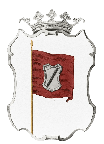
Fortresses and castles were created, of course, due to wars… The Livonian War of 1558–1583 brought much suffering to the residents of the small town and its surroundings. In 1562, the lands of Veliž were seized by Prince Radziwiłł. In 1582, the town passed to the Polish-Lithuanian Commonwealth. In 1585, Veliž received its own coat of arms: on a blue background of the shield—a golden cross, at the bottom—a sword, pointed east. Familiar motifs for Belarusian heraldry, if we look closely at some coats of arms of the Vitebsk region…
From 1667, according to the Andrusovo Treaty (during the Russo-Polish War of 1654–1667), the town passed to Muscovy. A decade later, the settlement-fortress returned to the Polish-Lithuanian Commonwealth. This became possible as a result of a large exchange: several towns and lands were exchanged for the capital city of Kyiv. And only as a result of the First Partition of the Polish-Lithuanian Commonwealth did Veliž finally return to Russia.
Initially—as a city of the Pskov province. And later, from 1804, it became part of the Vitebsk province…
Here it is time to recall the Veliž Case of 1821–1835, based on the false accusation of a group of Jews in the ritual murder of a 3-year-old boy. At that time, 42 people were arrested. In 1835, the case was closed. The accused were acquitted, and the false witnesses were exiled to Siberia. The Veliž Case attracted the widest public attention. The famous Russian poet Mikhail Lermontov even wrote a play titled “The Spaniards” on this occasion.
As for the uprising of 1918, it was triggered by the introduction of a grain monopoly, the notoriously known Soviet food rationing. The insurgents captured Veliž in November 1918. The number of armed peasants exceeded a thousand… And although the uprising was quickly suppressed, the armed peasants hid in the surrounding forests until 1925.
All these pages of memory, common to the peoples of Russia and Belarus, you will be able to discover, to leaf through yourself, if you manage to visit today’s Smolensk district center and the excellent, historically rich local history museum. In the very center of Veliž. And although the modern museum, located in a monument of 20th-century architecture (the so-called “trading rows”), was opened in 1986, its roots go back to much earlier times. Once, in 1918, the city museum began its work in the building of the city hall. However, the building was destroyed during the Great Patriotic War. By the way, the theme of war, heroism, and courage of the natives of the region, the dramatic events that took place every one of the 601 days of wartime hardships, is the main content of the museum’s exhibition. Here you can find materials about the defenders of the Brest Fortress, about the partisan movement not only in Smolensk but also in Vitebsk. When the museum was recreated (the basis was the collections of two school museums in Veliž), many documents and historical local history books were copied by local historians in Minsk, Mogilev, and Vitebsk.
The museum also tells about the intersection of the histories of Veliž and Vitebsk, Vitebsk through artistic exhibits—the works of the People’s Artist of Belarus Andrei Anufriyevich Bembel. A native of the Smolensk town, the future sculptor, who brought fame primarily to the Belarusian homeland, received his first lessons in craftsmanship at the Veliž Art School back in 1919. At that time, this educational institution had an outstanding cohort of graduates from the St. Petersburg Academy of Arts—painters V. Volkov, M. Ende, V. Khrustalyov, sculptors M. Kerzin, M. Shultz. In 1923, they all moved as a friendly team to Vitebsk: to work at the art technical school. Mikhail Arkadyevich Kerzin (1883–1979), a native of St. Petersburg, became the director of the technical school. He would hold this position for almost ten years until he moved to Minsk. Art historians noted the warmth and spirituality in Kerzin’s sculptures, the perfection of modeling, and high culture.
However, Vitebsk art historians recall different stories about those times. There was another story in the Vitebsk art school… In 1924, Andrei Anufriyevich Bembel joined his Veliž teachers—as a student. By the way, it is worth mentioning that the legendary painter Roman Semashkevich was also a student of the Veliž teachers while studying at the Vitebsk Art Technical School… And if you happen to see the sign of the art school on Dzerzhinsky Square in Veliž, be sure to remember the glorious artistic names that unite Belarus and Russia, Smolensk and Vitebsk, Veliž and the Belarusian region… Names that are common for the Motherland in Russia and Belarus…
Ales Karlyukevich
Postcards from the collection of Vladimir Likhadzedau
Weekly “Voice of the Homeland”, No. 9 (3177), Friday, March 12, 2010