Dear listeners, from the new year we invite you to a series of broadcasts dedicated to historical Belarusian settlements that, due to changes in borders, have found themselves outside of Belarus, but are still culturally and mentally connected to it.
Our journey will take place along the borders of the former Grand Duchy of Lithuania – a state that once united all ethnographic Belarusian lands.
In today’s historical journey, we invite you to visit the city of Veliž. Where is it located and what does it look like today? – This is explained by geographer Vladimir Mikhnevich.
First, I would like to quote an excerpt from the story “Journey to the City of Veliž” by the Russian traveler Lev Uskin: “It was a Jewish place – and Jews, as is known, will not live where it is bad…” – the author continues: “Such a strange place on our planet, where Jews are considered the indigenous inhabitants…”
The region I will be discussing in the upcoming programs was a border area in the Grand Duchy of Lithuania, and at the same time, it is a region that has changed hands many times between the Lithuanians and the Muscovites, and vice versa. In particular, such a fate befell the town of Veliž, the name of which is correctly pronounced with an emphasis on the last syllable.
It is indeed a small town located just 12 kilometers from the Belarusian border in the Smolensk region. The first mention of it is found in the chronicle of Bykhovets under the year 1392, where Grand Duke Vytautas prepares a military expedition to Pskov lands: Veliž and Krasnoye. The history of the town is closely linked to such notable figures as Grand Duke Casimir IV Jagiellon, the noble families of Orlovsky and Serafimovich, and the name of protodeacon Mikhail Navitsky.
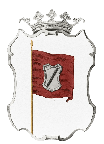
After Veliž returned to the Duchy in 1582, the town received the status of a starostwo from Stephen Báthory three years later on March 20, 1585, along with privileges and its first coat of arms – a four-pointed golden cross with a sword beneath it. The annexation of Veliž to Russia in 1772 led to a change of the coat of arms from the previous cross with a sword to… the Pahonia – this occurred on September 21, 1781. The coat of arms consisted of two horizontal fields: at the top, a double-headed eagle – at the bottom, the “Pahonia.” It symbolized the subordination of the town to Russia, thanks to the eagle’s dominance over the knight.
By the end of the 19th century, nearly 19,000 people lived here – now there are half as many. On the internet page of the residents of Veliž, it can be learned that the town became part of Poland in 1580. However, on another tab of the same page, there is information about the city’s inclusion in the Commonwealth, which for most Russians is synonymous with Poland. The earlier period from 1318 to 1536 is described by local historian Vladimir Myadvedev on the same page as the period of Veliž’s belonging to Lithuania.
It is pleasing that finally something has been written about the Duchy, but the Grand Lithuanian period is mentioned only indirectly everywhere. For example, while describing the former Ilyinsky Church, one can learn that it was built in the early 15th century by Grand Duke Casimir IV Jagiellon in honor of the miraculous salvation of his wife and daughter, who nearly drowned while crossing the Western Dvina River on the feast day of Saint Elijah the Prophet (the event took place during the Lithuanian-Muscovite wars). In 1781, a brick building was erected on the site of the ancient wooden church, characterized by the silhouette typical of Uniate churches.
By the way, in 1800, there were 7 Uniate churches (3 brick, 4 wooden) and 2 brick Catholic churches in the town. By the end of the 19th century, exactly 100 years later, there were 11 Orthodox churches and 1 church. Now, of all the listed sanctuaries, only the Trinity Church, built in 1866 and consecrated in 1869, remains.
During the Soviet period, spiritual life in Veliž completely faded, but sacred buildings remained. World War II finished the job: all sacred architecture, except for the Trinity Church, was destroyed. The fate of Christian temples also befell 9 synagogues. In addition to the only currently existing historical temple in Veliž, there is an evangelical church of Christian Baptists. Furthermore, in 2006, the construction of a wooden Orthodox church of Cyril and Methodius began.
I recommend getting acquainted with the rich history of the town, and I advise visiting the local museum, which has information about Veliž’s inclusion in the territories of the Toropets, Vitebsk, Smolensk, and Lithuanian principalities, as well as in the Commonwealth, later in the Vitebsk Governorate of Russia, and the Pskov Governorate. There is information about the construction of a border fortress. In addition to all this, the museum’s exhibition includes some works by the People’s Artist of Belarus, Professor A. Bembel.
You can stay at the “Dvina” hotel, located on the left bank of the Western Dvina in the very center of the city. There are single, double, triple, and quadruple rooms available. A bank and an ATM are located within a three-minute walk from the hotel. You can eat at the café or restaurant “Velizhanка” or “Dvina.” Buses from Vitebsk run daily at 12:00 and 19:30 Belarusian time. I invite you to Veliž.
Listen to the episode “Journey to the City of Veliž” Audio2,74 MB