SMOLENSK
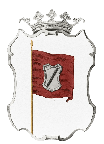
Coat of Arms: in a red field, the figure of Archangel Michael. Obtained on November 4, 1611.
An ancient Slavic settlement, the first mentions of which date back to the 9th century. According to Nestor’s chronicle, at that time it was the capital of the Krivichs, whose lands occupied the upper reaches of the Dvina, Dnieper, and Volga rivers. In the first quarter of the 11th century, local princes began to establish themselves. The son of the Polotsk princess Rogneda and the Kyiv prince Vladimir, Grand Prince Yaroslav, while dividing his lands among his descendants, granted the Smolensk principality to Vyacheslav. At that time, the principality encompassed significant territories, including parts of Vitebsk, Pskov, Moscow, etc. However, this dynasty was unstable, and many princes changed on the Smolensk “throne.” In 1125, the throne was taken by the son of the Kyiv prince Mstislav – Rostislav, who became the progenitor of the dynasties of Smolensk, Yaroslavl, Vyazma, and others. In the 13th century, the city had strong ties with Riga, as evidenced by trade treaties with it and the “German shore.” In 1230, it came under the influence of the Polotsk principality, and from the late 13th century, close ties between the Grand Duchy of Lithuania and Smolenshchina began. During Algirdas’s campaigns against Moscow (1368, 1370), he found military support from Prince Svyatoslav. His son Yuri Svyatoslavich was supported by the Grand Duchy of Lithuania in 1386 during the struggle for the Smolensk throne.
In 1395, representatives of Vytautas were installed in Smolensk, but in 1401 the city came out from under the protection of the Grand Duchy of Lithuania and only returned on June 24, 1404, for 110 years into the sphere of economic and cultural influences of Europe. According to some sources, Vytautas granted the city the privilege of Magdeburg rights (if this information is true, then Smolensk enters the top five Belarusian Magdeburg cities). This period of peaceful development (despite the uprising against the governor – Andrei Sakovich in 1440) was solidified by a treaty between Grand Duke Casimir and Moscow Grand Duke Vasily the Dark in 1449. According to it, Moscow renounced Smolensk and Smolensk land forever. Despite this treaty, in 1500, the Moscow Grand Duke Ivan Vasilyevich laid siege to the city three times (from 1501 to 1514), but was repelled twice by the armies of the Grand Duchy of Lithuania under the command of Yuri Patsev and Nikolai Salogub. Only during the third siege, at the instigation of Mikhail Glinsky, the townspeople revolted, and the royal troops entered the city on August 1, 1514. Moscow, at the request of the Smolensk citizens, preserved their previous privileges. This period of Moscow rule lasted 96 years. On September 16, 1610, the troops of Sigismund III Vasa besieged Smolensk. After 20 months of siege, on June 3, 1611, the city was returned. The Muscovites unsuccessfully attempted to recapture it in 1613-1615.
In 1611, Smolensk received Magdeburg rights. It had two biweekly fairs, weekly markets, a goods warehouse, city scales, a bathhouse, an inn with revenues from them for the benefit of the entire city, permission to create craft guilds, etc., as well as a coat of arms. Twenty years later, Moscow troops under the command of M. Shein attempted to take the city, but the appearance of an army led by the king and Grand Duke of the Polish-Lithuanian Commonwealth Władysław IV changed the course of the campaign, and the Muscovites capitulated on February 1, 1634.
In 1654, the troops of Tsar Alexei Mikhailovich, after a two-month siege, forced the capitulation of the warriors who heroically defended the city (September 29). In the 17th century, the city’s population numbered over 80,000 residents, and in 1600 there were more than 8,000 buildings. After 180 years, the population decreased to 2,875.
In 1708, the Smolensk Governorate was established, which became part of the Riga Province in 1719. From 1776, Smolensk was the center of the vicegerency, and from 1796, again a governorate. In 1824, the general governorship of Vitebsk, Mogilev, and Smolensk was created with its center in Vitebsk, which existed until 1855. As a gubernatorial center, Smolensk existed until the early 1920s of the 20th century.
It was part of the declared Belarusian People’s Republic in March 1918.
According to the decision of the Central Committee of the Communist Party (Bolsheviks) of Belarus, at the end of December 1918, a decision was made to create the Belarusian Soviet Socialist Republic, which was proclaimed on December 30-31 in Smolensk. A week later, the capital of Soviet Belarus was moved from Smolensk to Minsk. On February 25, 1919, Smolensk, along with Vitebsk, Mogilev, and Gomel, was annexed to the RSFSR.
Source (with modifications):
A. Tsitov.
Symbols of Independence. // Heraldry of Belarusian Cities.
Minsk, 1998.
Belarusian Shelf