O.L. Grushetsky
In the mid-17th century (according to various sources, 1663–1665), a daughter named Eufimia-Agafya was born at the estate of Smolensk nobleman Semyon Fyodorovich Grushetsky.
Her father was a Moscow nobleman (1658–1668), and from 1668 served as voivode in Chernavsk (Oryol Governorate, Yelets District). For some time he also managed the estates of the Grand Hetman of Lithuania, Michał Pac. Agafya’s grandfather was a serving nobleman who first returned to his homeland, Lithuania (the Polish-Lithuanian Commonwealth) – to the Smolensk Voivodeship, then to the Vitebsk Voivodeship, and later ended up again in the Muscovite state, where he received a post in the administration of the city of Kashin. They descended from the ancient Polish noble family of Grushetsky bearing the coat of arms Lubicz, tracing their origins to the time of the Battle of Grunwald. The founder of the Grushetsky lineage, the knight Matvey (Maciej), was the Crown standard-bearer of King Jagiello. As a knight in 1411, he received from the king for “bloody merits” the villages of Grushki (Grushitsy) near Lublin (Poland), from the name of which the family surname originated.
The Russian branch (from which Agafya traces her ancestry) of this family was entered in Part VI of the genealogical books of the Moscow, Pskov, and St. Petersburg governorates (General Armorial, II, 85). This branch traces its origin from Karp Yevstafyevich Grushetsky (born in the second third of the 16th century), who left Poland for Moscow between 1584 and 1598 to serve Tsar Fyodor I Ivanovich. He was granted estates in the Kashin District and was given many villages and hamlets. However, whether he departed for Russia from the territory of modern Poland or from the territory of Belarus (possibly even the Smolensk region, which at that time belonged to the Polish-Lithuanian Commonwealth) is still not definitively known, as we may be speaking of the Polish-Lithuanian Commonwealth as a whole, which at the time included both Poland and Belarus (Lithuania), as well as the Smolensk lands. Thus, the Belarusian branch of the Grushetsky family was entered in Part VI of the noble genealogical book of Mogilev Governorate (though by a Senate decree in 1850 they were moved to Part I of this book). The son of the founder of the Belarusian branch (the first known in this branch), Sebastian (Sevastyan) Grushetsky, in 1663 also had real estate in the Smolensk Voivodeship, as confirmed by the order of Paweł Sapieha, Hetman of Lithuania, dated October 27, 1663. And in the armorial of the Polish historian and genealogist Adam Boniecki, it is noted that in 1660 two brothers lived in the Smolensk Voivodeship: he (Sebastian) and Kazimierz Grushetsky. Kazimierz was also “granted an estate” in the Orsha District, lived in the Mstislavl Voivodeship, and owned there “by inheritance from his predecessors the estate of Komarovichi” (Cherikov District, Mogilev Region). From Kazimierz came descendants who in the 19th century lived in the Kopys, Mogilev, and Chausy districts of Mogilev Governorate. And his grandson, Nikolai (Mikołaj) Alexandrovich, was a courtier of His Royal Majesty. Moreover, in documents describing the siege of Smolensk in 1654 (the Russo-Polish War of 1654–1667), which was then part of the Grand Duchy of Lithuania, mention is made of a certain Rygor (Grigory) Grushetsky, who was most likely a rotmistr at that time. The documents state that in the summer of 1654 he received a conscription letter for 600 men for the defense of Smolensk, whom he was to bring. At that time this was the maximum number for a chorągiew (a military unit of Poland and the GDL), and the number was simply enormous, which can only speak to the significance of this person. His relationship to any of the branches has not yet been traced; one can only assume that it was to the Belarusian branch, since the Russian one has been studied more thoroughly, and he fought on the side of the Commonwealth’s forces.
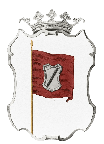
Coat of Arms of the Grushetsky family
So, to this day it is still difficult to say precisely where the founder of Agafya’s branch appeared in Russia from – specifically from Poland, or from the Smolensk, and at that time Belarusian (Lithuanian), lands. Only one thing is known – from the Polish-Lithuanian Commonwealth, which included both Poland and Belarus (Lithuania). Nevertheless, one can assert with full confidence that Agafya Grushetskaya’s ancestors long lived and owned estates on the territory of both historical Belarus (Lithuania) and modern-day Belarus.
The young noblewoman, with ancient Polish roots, was apparently raised more freely, in a European manner, than the maidens of that time at the Moscow court. And her manner of dressing, according to the modern historian P.V. Sedov, went beyond Moscow customs. The girl followed the more contemporary, Polish fashion. Thus, Agafya wore a hat in the Polish fashion, leaving her hair uncovered, which at the time went beyond Moscow customs (recall the Russian kokoshnik, when every hair had to be tidied and hidden). The girl held bold views and knew how to defend her opinion. The Russian writer A.I. Krasnitsky, in his novel “The Polish Tsarina” (written in 1902), describes her as one of the most beautiful girls of her time. Moreover, he notes her education – she could read and write, spoke Polish fluently, understood Latin books, had a fairly clear understanding of life in the West, and even understood if someone spoke French in her presence; she played the harpsichord. He also writes that people said of the blue-eyed beauty Agafya: “Her face is that of a heavenly angel, and her mind is bright.”
On April 4, 1680, on Palm Sunday, during the procession of the cross, 18-year-old Tsar Fyodor Alekseevich first saw the beautiful Agafya “among many watching people” as he walked in the procession behind the holy icons. The girl greatly pleased the tsar, and he assigned his royal valet Ivan Maksimovich Yazykov to make inquiries about her. It was discovered that this girl was Agafya Semyonovna Grushetskaya, and she lived with her mother in Kitai-gorod in the house of her cousin uncle, the Duma nobleman Semyon Ivanovich Zaborovsky, who until 1677 had managed the Monastery Chancellery. Fyodor ordered Zaborovsky to be told “that he should guard his niece and not give her in marriage without an order.” According to the historian Sedov, not only beauty, but also her manner of dressing could have helped draw the tsar’s attention to her in the crowd.
The young tsar fell in love with the fashionably dressed young beauty; however, not wishing to violate ancient customs, the tsar ordered all beautiful maidens from high society to be gathered in July 1680 for a bride-show. In total there were 19 maidens, including Grushetskaya – girls from the upper strata of society, daughters of boyars and princes. However, the outcome had already been predetermined – the tsar chose as his wife the Agafya he had fallen in love with, a girl from a noble but not the most prominent family.
Tsar Fyodor Alekseevich
One of Fyodor Alekseevich’s closest relatives, his uncle Ivan Ilyich Miloslavsky (the brother of the tsar’s mother), who did not want to allow anyone near the throne except the Miloslavskys, upon learning of the tsar’s choice, began spreading slanderous rumors about the royal bride in order to prevent Agafya from appearing in a leading role at the royal court, which contradicted his plans and could weaken the influence of his family at court. Miloslavsky told the tsar that “her mother and she are known for certain improprieties!” which greatly upset the young tsar. However, the tsar’s confidants persuaded him to verify these words. His closest associates, Ivan Maksimovich Yazykov and Aleksei Timofeyevich Likhachev (tutor of Tsarevich Aleksei Alekseevich), went to Semyon Zaborovsky, Agafya’s uncle, with whom she lived. Those who came to Semyon Zaborovsky’s house began discussing how to ask the maiden about such a delicate matter, but Agafya, having heard their conversation, came out to the guests herself and said directly “that they should have no doubt about her honor and she affirms this to them upon peril of her life!” According to the modern historian A.G. Kuzmin, this attempt by Ivan Miloslavsky to slander the royal bride, Agafya Semyonovna Grushetskaya, was broken by the persistence of the groom, Tsar Fyodor Alekseevich, and the remarkable boldness for that time of the bride herself, who proved capable of standing up for herself. And Miloslavsky’s slander only brought the tsar’s wrath upon him, and only Agafya Semyonovna’s intercession saved him from royal disgrace. The merciful tsarina petitioned His Majesty for Miloslavsky’s forgiveness. Fyodor Alekseevich again allowed Miloslavsky to appear at court, but his influence never returned. The young Agafya Semyonovna was fully exonerated from the slander, and the tsar married her.
As the famous Russian historian V.N. Tatishchev (1686–1750) noted: the tsar, “having fallen in love with Grushetskaya, would not marry anyone except her. His nursemaid and tutor, though they wanted him to marry another, defamed Grushetskaya with many accusations, but he, having been assured by her herself, was wed.”
On July 18 (July 28 new style) 1680, in the Dormition Cathedral of Moscow, the wedding of Fyodor Alekseevich to Agafya Semyonovna Grushetskaya took place. However, the wedding itself was celebrated without any ceremony or splendor, very modestly. The Dutch resident Baron Johann Keller described the royal wedding in his dispatch of July 20:
“…last Sunday his Tsarist Majesty celebrated the rite of his wedding; his spouse became none of the princesses about whom I wrote in the postscript of my last letter and who were escorted to the Palace so that his Tsarist Majesty could choose a bride from among them, but rather a person from a not very wealthy family and belonging rather to the Polish nation than to the Russian; his Majesty by this wished to openly prove <…> that he firmly wants to express his will, and not follow in this regard the will of the grandees of the Court: <…> for if he were to marry into a famous family, which through this would become too important and too powerful and would thus seek to oppress the less noble, this could lead to dangerous quarrels.”
The tsar’s tutor, the poet Simeon Polotsky, and his pupil, the new court poet monk Sylvester Medvedev, composed odes to this “great and joyful celebration for all the land of Rus.” And the country was notified by a laconic circular charter.
Icon “St. Fyodor Stratelates and Martyr Agafya”
After the royal wedding, the tsar bestowed ranks and estates upon his wife’s relatives. Thus, Agafya’s cousin uncle on her mother’s side, Semyon Zaborovsky, was elevated to the rank of Duma noblemen, and from July 20 – to boyar. In 1681, the tsar gave him the village of Vasilyevskoye (Ruza District, Moscow Region). Agafya’s sisters, Anna and Fyokla, were married to prominent grooms: the first to the Siberian prince Vasily, and the second became Princess Urusova; additionally, they received generous dowries. Cousins Grushetsky – Kondratiy and Mikhailo Fokichi – received the boyar rank of “zhiltsy,” the junior rank at court. On May 2, 1680, even before the wedding, Fyodor Alekseevich promoted the future tsarina’s cousin Vasily Fokich Grushetsky to stryapchiy. On July 17, the day before the wedding, Vasily Fyodorovich Grushetsky was promoted to stolnik, and on July 20 – to spalnik, having been a stolnik for only three days. On July 31, her cousins Kuzma Osipovich, Kondratiy, and Mikhail Fokichi were made the tsar’s chamber stolniks. The tsarina’s father, Semyon Fyodorovich, received the rank of boyar in 1680 (though some sources indicate he died in 1669, which is most likely incorrect). Agafya’s mother, Boyarynya Maria Ivanovna Grushetskaya (née Zaborovskaya), was granted the village of Vasilyevskoye with Ordyntsy, Borisovskaya, Bykovka, and Byakontovo (Podolsk District, Moscow Region). The new royal relatives and in-laws immediately occupied a privileged position among Moscow’s ranks. The Grushetskys and Zaborovskys, along with their near and distant kin, entered the upper ranks of the capital’s nobility as a large clan.
After the wedding, the tsar undertook the construction of new wooden chambers for himself and his wife, as well as for his sisters, the elder and younger tsarevnas. The royal chambers were built near the terem by the western wall of the Resurrection Terem Church; the chambers of his stepmother Natalya Kirillovna were also moved here.
Tsarina Agafya Semyonovna, unlike many of her predecessors, played a significant role in court life and exerted strong influence on her husband. Under her influence, court life changed significantly. Thus, Tsar Fyodor Alekseevich was the first Russian to wear Polish dress, which was then followed by all the courtiers; he abolished the custom of shaving the head and began wearing long hair. The historian I.I. Golikov (1735–1801) wrote:
“The tsar did not love magnificence either in clothing, or at table, or in furnishings. The monarch supported this economy by ordering that no one wear Tatar dress and that they dress in a manner similar to the Polish, or the ancient Russian, suitable for the northern climate.”
Many innovations appeared in the royal chambers. Thus, many courtiers, including important elderly boyars, began trimming their beards and openly smoking tobacco. Some of the boyars, in addition, began wearing short-skirted German dress.
Agafya Grushetskaya brought much good to the Muscovite state; she “persuaded her husband to abolish the okhabni, ugly women’s garments… to introduce the shaving of beards and the cutting of hair, Polish sabers and kontush coats, and, what is even more important, to allow the founding of Polish and Latin schools in Moscow.” Warriors finally stopped wearing the shameful women’s okhabni, which soldiers who had fled the battlefield were required to wear.
In Moscow, at the insistence of the young tsarina, several Latin and Polish schools were established, which spoke to her educational activities and influence. Also, thanks to the influence of Agafya Semyonovna, it was ordered to remove from churches the icons that parishioners had placed in their temples each personally for themselves, as their own patron deities (they prayed to these icons and lit candles only themselves, not allowing anyone else to do so).
The young tsarina, thanks to her freer upbringing than was customary in Moscow at the time, was also distinguished by a rare boldness for her era. She allowed herself to appear openly before people and often sat and walked alongside the tsar, which had never happened before. The presence of a decisive character, according to the historian P.V. Sedov, allowed her to transgress the centuries-old prohibitions of the Moscow court. The presence of Tsarina Agafya Semyonovna beside Tsar Fyodor Alekseevich changed the established customary order of court life of that time.
Shroud of Tsarina Agafya Semyonovna
However, all these innovations apparently could not fail to generate certain rumors, gossip, and intrigues in Moscow. Talk began to appear in the city about the tsar’s intention to adopt the “Polish (Lyatsk) faith,” and people recalled False Dmitry and his wife, the Polish woman Marina Mnishek. According to the historian D.L. Mordovtsev (1830–1905), all these intrigues could not have been directed by anyone other than the powerful and ambitious Tsarevna Sophia Alekseevna, Fyodor Alekseevich’s sister.
In addition to innovations at court, Tsarina Agafya also brought about a revolution in women’s court fashion; she herself wore a hat in the Polish fashion, leaving her hair uncovered, which went beyond the Moscow customs of that time. These hats even received the name “Polish hats.” These were velvet caps with fur brims of marten, beaver, and sable. Under the hat itself, a rantukh was worn (a traditional Polish women’s headdress, which is a large veil of light, thin fabric covering the head and shoulders). The edges of the Polish rantukh were trimmed with embroidery or gold stitching. The rantukh reliably covered the hair, while for young unmarried women the hair could be slightly covered. Polish court ladies of the second half of the 17th century already left their hair uncovered. However, in Moscow palace documents of that time there is no information about materials for a rantukh, from which, according to the historian P.V. Sedov, one can assume that the tsarina did not cover her hair completely, but arranged it with lace, which is why in Moscow documents such hats were sometimes also called “maiden’s.”
The first mention of such “Polish hats” of Agafya dates to September 19, 1680. The name day of Tsarevna Sophia Alekseevna was celebrated at the palace on that day, and for Agafya Semyonovna a “hat of velvet in the Polish style was sewn, with a rim of a pair of sables <…>, in the cutting, two vershoks of velvet were used, for the lining, a quarter of white belly fur. To be given for making to the Novomeshchanskaya Sloboda Pole Semyon Vasilyev son Kareshenkov. He was also given to make another hat, the velvet is also scarlet, with a sable rim <…>, a silver lace arshin.” Already on the next day, September 20, for the greatest fashionistas in the royal terem, the young tsarevnas Yekaterina and Maria, “Polish hats” were also sewn, which followed from the new headdress of the tsarina having been a success at the palace celebration.
Tsarevna Maria Alekseevna also dressed “in the Polish manner,” and Tsarevna Yekaterina Alekseevna even after the death of Tsar Fyodor Alekseevich wore “a hat and dress in Polish taste… abandoned Moscow kaftans, stopped braiding her hair into a single braid.” Likewise, Feodosia and Marfa Alekseevnas continued wearing “Polish hats.” As did the second wife of Tsar Fyodor Alekseevich, sixteen-year-old Marfa Matveyevna Apraksina, whom the tsar married after Agafya Semyonovna’s death, who also became enamored of the new fashion. A witness to all these innovations was, of course, Peter I, the future Emperor of All Russia, who at the time of Agafya Semyonovna’s reign was already 9 years old. The young tsarina was his sister-in-law (his brother’s wife). One cannot exclude the possibility that she may have had some influence on his fascination with all things European in fashion, though this is, of course, only a supposition.
The historian Sedov characterizes Agafya Grushetskaya as a pious Moscow tsarina, full of virtues, merciful and interceding before the tsar even for her ill-wishers. In addition to the fact of Agafya’s forgiveness and intercession for the slandering Ivan Miloslavsky, another fact speaks to her virtue – in those times, Bogdan Fyodorovich Polibin, who served in the Kholop Chancellery (later a chancellery judge), a man truthful and respected by people, but who was also disliked by Miloslavsky, being in extreme need, borrowed 300 rubles, pledging a village, but could not repay the entire debt on time. The clerk of his chancellery advised Polibin to take the missing sum of money from the chancellery, and repay it over time. This was reported to Miloslavsky, who informed the tsar that Judge Polibin had stolen 300 rubles from the treasury. Fyodor Alekseevich initially believed this and ordered him punished and exiled. The tsarina, having heard this, asked Miloslavsky why and how he had done this, to which he replied that he had not inquired into the full details of the matter. At this, the tsarina scolded him angrily, saying that he condemns a man without trial and, not knowing the matter fully, reports to the tsar. The tsarina ordered the entire matter investigated, learned more about Polibin, and, having learned all the details, sent 300 rubles via Ivan Potemkin. Agafya Semyonovna not only saved Polibin from trouble but also generously rewarded him.
Tracing of burial fabric from the burial of Tsarina Agafya
During the reign of Agafya Grushetskaya, another innovation appeared – the tsarevnas received some financial independence. Whereas previously goods bought by them or taken on credit by the Mastery Chamber Chancellery were brought to the tsarevnas’ chambers, now the tsarevnas could themselves order a purchase of this or that item, commanding payment to be made at the chancellery.
On the night from Sunday to Monday, July 11 (21), 1681, the tsarina gave birth to a son named Ilya, in honor of her great-grandfather Ilya Danilovich Miloslavsky. On July 17, Ilya was baptized in the terem palace church. The godfather of the tsarevich was the abbot of the Florishcheva Hermitage, Ilarion; the godmother was Tsarevna Tatyana Mikhailovna. The heir was entrusted to the care of Boyarynya Anna Petrovna Khitrovo, who had cared for the tsar himself from his childhood.
However, three days after the infant’s birth, on July 14 (24), “in the first quarter of the first hour of the day, on the feast of the Apostle Aquila,” due to puerperal fever, Agafya Semyonovna died. Her death was a heavy blow for Fyodor Alekseevich: he escorted the coffin to the Red Porch and to the “sledge,” but was unable to attend the burial itself at the Ascension Monastery, and throughout the forty-day mourning period there was no procession to memorial services; only on the fortieth day, August 22 (September 1), did the tsar attend a memorial service at the Ascension Monastery. The historian V.N. Tatishchev wrote that after the death of Agafya Semyonovna, Tsar Fyodor Alekseevich:
“As this sovereign in his marriage with Tsarina Agafya Semyonovna were blessed with complete happiness and the utmost love, and by the example of spousal love displayed true virtue, which to the delight of both Their Majesties and all their subjects gave great hope of desired succession through the sign of pregnancy. But by the will of the Most High, having given birth to His Majesty’s tsarevich, she soon to the great sorrow of all passed away, and shortly after, the said newborn tsarevich followed her. By which His Majesty was so grieved that for several days he did not wish to speak with anyone or consume food. And though his closest associates strove by all means to cheer him, nothing could they accomplish, and His Majesty from such grief soon fell ill.”
Removal of sarcophagi before the destruction of the Ascension Monastery
Unfortunately, the infant survived his mother by only a week. The newborn Tsarevich Ilya Fyodorovich died on July 21 (31). The grieving tsar could escort him only to the Red Porch and to the sledge and did not go to the Archangel Cathedral for the burial.
Six months after these losses, the tsar married Marfa Matveyevna Apraksina (born 1664), but two months after the wedding, the sovereign suddenly died in Moscow at the age of 21, having left no heir. And a year after the death of his firstborn, Ilya, Peter I ascended to the Russian throne, proclaimed in 1682 at the age of 10 as Tsar of All Rus. Later, in 1692, Peter I buried his second son, Alexander Petrovich, beside the young Tsarevich Ilya Fyodorovich.
In 1929, the Ascension Monastery, which had served in the Middle Ages as the burial place of representatives of the Moscow grand ducal family and in which Agafya Semyonovna was buried, was destroyed by the Bolsheviks, and the white stone sarcophagi with the remains of the tsarinas were transported to the underground chamber of the southern annex of the Archangel Cathedral, where they remain to this day. On the lid of the sarcophagus, the tsarina is recorded with the inscription:
“In the year 7189, on the 14th day of July, on a Thursday, in the first quarter of the 14th hour of the day, on the feast of the holy Apostle Aquila, the servant of God, the spouse of the pious sovereign Tsar and Grand Prince Fyodor Alekseevich of all Great and Little and White Russia, Autocrat, the pious sovereign Tsarina and Grand Princess Agafya Semyonovna passed away and was buried in this place on the 15th day of July.”
During the examination of the burial of Tsarina Agafya Semyonovna Grushetskaya, researchers of the later sarcophagi of the necropolis of the former Ascension Cathedral of the Kremlin, which served as the ancestral burial vault of grand princes and first tsars of Russia (first from the Rurikovich dynasty, then the Romanovs), discovered to their great surprise on the skeleton, on the chest under the clothing, a gold pectoral cross decorated with colored enamel and inscriptions – in earlier burials of this vault such crosses had not been found. The tsarina’s body at burial was wrapped in a silk shroud. Her headdress was perfectly preserved – a volosnik on a lining. However, only insignificant fragments of Agafya Grushetskaya’s shroud and dress survived, which nevertheless did not prevent researchers from reconstructing the shroud’s design.
The first known historian to provide a description of the life of Agafya Semyonovna Grushetskaya was Vasily Nikitich Tatishchev (1686–1750). His father, Nikita Alekseevich, from 1678 was listed in state service as a Moscow “zhilets,” which was during the years of Agafya Semyonovna’s reign. Information about court figures of the late 17th century, including Agafya Grushetskaya, was provided to Tatishchev by the famous diplomat, Peter I’s relative by marriage, Boris Ivanovich Kurakin, who, among other things, was married to the niece of Tsarina Agafya Grushetskaya – Princess Maria Fyodorovna Urusova (daughter of Prince Fyodor Semyonovich Urusov and Princess Fyokla Semyonovna Grushetskaya, the tsarina’s full sister). Tatishchev’s works describe the period from the girl’s acquaintance with the tsar to her very last days. Entries about her in Tatishchev’s work “History of Russia” appear in volumes I and VII.
Modern historians frequently rely in their biographical research on Agafya Grushetskaya on archival materials of RGADA, particularly Fund 396, Inventory 2, Files No. 872 and No. 873.