Jerzy Besala
Polish-Russian History of Smolensk
This city has long dramatically intertwined with Polish and Russian history. Its retention meant control over the main route from Poland to Moscow and provided an advantage over disputed territories.
Smolensk first appeared in the chronicles in the 9th century as a stronghold of the Krivich tribe. It was part of the Kievan Rus’ and later became the capital of the Smolensk Principality; in the 12th century, the Assumption Cathedral was erected on one of the hills. However, the stronghold could not maintain its independence when the Lithuanians under Olgerd (1345–77) appeared, who claimed that “all Rus’ should belong to Lithuania.” In 1395, the Grand Duke of Lithuania, Vytautas, captured Smolensk.
Another great power emerged on the scene: the Moscow state. The struggle between Moscow, Lithuania, and Poland was from the beginning a battle of ideologies and sanctity. In the 10th century, Kyiv and Novgorod considered themselves the new Jerusalem, and Rus’ as the promised land. The marriage of Ivan III to the granddaughter of the Byzantine Emperor, Zoe Palaiologina, in 1472 strengthened the tendencies to seize Rus’ lands, as the rulers of Moscow considered themselves heirs to Byzantium. In 1478, Ivan III demanded from Lithuania the territories of Polotsk, Vitebsk, Smolensk, and all Rus’ lands.
The sacredness of Smolensk was contributed to by the miraculous icon of the Smolensk Mother of God, which was said to have been created by Luke the Evangelist (he is also credited with painting the icon of Our Lady of Częstochowa). The placement of a copy of the icon by Boris Godunov in 1602 above the Dnieper Gate undoubtedly doubled the efforts of the Russians in defense of sanctity, just as it did for the Poles in their fight for Jasna Góra.
On July 14, 1500, near the river Wiedrosza, the troops of Ivan the Terrible defeated the ten times weaker forces of the Lithuanian hetman Konstanty Ostrogski and approached Smolensk. On September 6, 1502, they began a general assault. However, the garrison of the fortress not only defended itself but reportedly cut down as many as 6,000 Moscow soldiers in numerous sorties. The lands around Smolensk were completely devastated, and therefore the exhausted parties agreed to a six-year truce: Lithuania lost in it the Siewierszczyzna and lands “from the Pskov borders to the Tatar steppes.” Smolensk, as well as Polotsk, Vitebsk, and Kyiv, became border strongholds of the Polish-Lithuanian Commonwealth.
Since Poland had formed a union with Lithuania, it became clear that the Crown would also become embroiled in a bloody conflict with Moscow over key fortresses securing Lithuania. In April 1507, the tsar with the Kazan horde struck one army at Polotsk and another from Dorohobuż at Smolensk. The war ended with another “eternal peace” sworn by the king on January 12, 1509, in Vilnius. Apart from a few Smolensk estates, Lithuania gained nothing, and more than a year later, Vasily III incorporated Pskov into the Moscow state.
Smolensk Lost
In January 1513, the troops of Vasily III approached Smolensk, and the commander of Smolensk, Voivode Yuri Sollohub, in a solemn oath promised King Sigismund to defend the fortress “to the death.” The time was ripe, as in mid-April 1514, a Moscow army led by the ambitious prince Mikhail Glinsky set out for Smolensk.
They surrounded Smolensk, but had no chance of capturing the powerful fortress. To aid Glinsky, a second army led by Prince Shchenya Obolensky arrived. By the end of June, the noose tightened even more when Vasily himself arrived at Smolensk with a third army. “It is said that for this siege, Vasily used over three hundred siege guns, commonly known as bombards,” wrote Jost Decius. In reality, there were about 140, mainly brought from Germany. But even they should not have breached the mighty ramparts – the royal secretary believed – “raised from earth, stones, and oak logs,” so that “no projectiles could harm it.”
The Jagiellonian was convinced that Smolensk was impregnable; especially since it was excellently supplied. Meanwhile, on July 31, 1514, unexpectedly, the fortress surrendered, and its inhabitants poured into the streets, swearing fealty to Vasily III! This was a shock for the king and his council, who had been in the vicinity of Minsk since July 26.
It is hard to say who contributed most to the capitulation. We know for sure that discontent was growing inside the fortress, and Sollohub was under pressure from the military and urban elders, inclined towards capitulation. On July 31, 1514, Vasily III triumphantly entered the fortress, ceremoniously welcomed by the Orthodox Bishop Varsonofy.
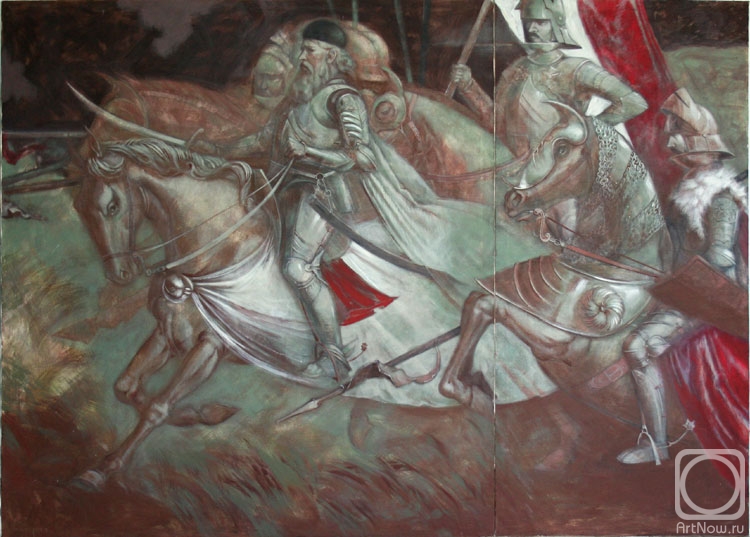
Was Sollohub a traitor to the king? He did not switch sides to Moscow but appeared in Orsha at the royal camp. Such is not the behavior of a traitor. Meanwhile, according to the “Utyuzhsky Chronicle” from the early 16th century, he was judged: “he was found guilty of treason there and executed in 1514 by order of Sigismund.”
To this day, we do not know if Sollohub became a scapegoat whose execution was meant to mask the king’s sluggishness in organizing a relief. The inhabitants of Smolensk quickly became disillusioned with the new rule: a few weeks of Moscow’s reign led Bishop Varsonofy to send to King Sigismund his “nephew Vasya Chodyin, assuring that the inhabitants would facilitate his recovery of the fortress.” The tsarist officials in Smolensk discovered the bishop’s collusion with the Polish king. He was summoned to Moscow and imprisoned.
The fate of Smolensk did not change with the great victory of the Lithuanian and Crown troops led by Konstanty Ostrogski. On September 8, 1514, near Orsha, they defeated the much larger Moscow army of Ivan Chelyadnin. Subsequently, Ostrogski approached the walls with 16,000 “drinking carts”: there the Polish and Lithuanian army saw the corpses of Smolensk inhabitants, supporters of a return to the Commonwealth, displayed by Vasily Shuysky. But since Ostrogski “had no guns… he returned to Vilnius,” wrote Maciej Stryjkowski.
The Necklace of Orthodox Rus’
The loss of Smolensk was so painful that Stańczyk did not fail to point it out to the king. For nearly a hundred years, Smolensk became a Moscow border fortress, and from then on, Moscow began to threaten central Lithuania. Appreciating the strategic location of the city situated among seven hills, Fyodor Romanov issued a decree on changing the fortifications of the fortress in the late 16th century: in 1596, the old ramparts began to be demolished and new stone ones built in their place. The works were directed by Fyodor Savilyev, nicknamed the Horse, and supervised by the future tsar Boris Godunov.
According to Russian studies, about 300,000 people were used for the works. We do not know how many died during these forced labor. But when Godunov saw the results of this work, he reportedly exclaimed in delight: “The walls of Smolensk are the necklace of our Orthodox Rus’… which has no equal on all the holy Russian land.” Stefan Batory did not attempt to recapture Smolensk. In the years 1579–82, he restored Polish rule over the Livonian territories. Only during the crisis of the Moscow state (the Time of Troubles) – when Tsar Vasily Shuysky made an agreement with the Swedes in Vyborg against the Commonwealth, did King Sigismund III Vasa decide to strike at Smolensk.
He appeared before the fortress walls on October 5, 1609. He saw a vast, well-fortified, albeit somewhat outdated fortress: the total length of the walls was 6.5 km, the height reached 15 m, the towers up to 33 m, and the thickness up to 5–6 m. The northern wall was protected by the Dnieper.
A siege to the death was anticipated, even though about 20,000 Cossacks joined the nearly 9,000 royal forces. But Sigismund III had to contend not only with the garrison of Smolensk led by the Smolensk voivode Mikhail Borisovich Shein but also with the complicated military and political situation in the Moscow state, as hetman Stanisław Żółkiewski entered Moscow after announcing Sigismund III’s son – Władysław – as the new tsar.
Dramatic negotiations with the great Moscow embassy that arrived at Smolensk, as well as with Voivode Shein, accompanied by riots in Moscow and its burning by the Polish garrison on March 29, 1611, did not bode well. The king even went so far as to intern the embassy led by Prince Vasily Golitsyn and Metropolitan Philaret of Rostov near Smolensk. It seemed that the Poles would not regain the fortress: but “when we had already despaired, when we had hung our necks and heads… when enemies were gathering from all sides,” as an anonymous observer wrote, after a violent assault on June 13, 1611, Smolensk was captured.
Victory of Władysław IV
In Poland, it was realized that the tsars would never reconcile with the loss of the fortress. Meanwhile, despite the parliamentary constitutions of 1620, 1629, and 1631, the defense of Smolensk deteriorated. After the death of Sigismund III in 1632, the Russians began to bring in huge quantities of cannons, muskets, and mercenary troops from the West, wanting to take advantage of the time of interregnum in the Commonwealth. However, the Poles and Lithuanians efficiently elected Sigismund III’s son, Władysław IV, as their ruler, who nominally still bore the tsarist title.

The defense of Smolensk was commanded by the Smolensk deputy voivode Samuel Drucki-Sokoliński. On August 27, 1633, the long-awaited relief arrived with King Władysław IV, who deployed his forces near the Hłuszczcy forest by the Dnieper. He had 14,000 troops against Shein’s 25,000 soldiers. Soon, however, the Poles and Lithuanians were supported by several thousand Zaporozhian Cossacks.
For privileges for Orthodoxy, obtained from Władysław IV, the Cossacks fought excellently. They served under a distinguished leader – Władysław IV demonstrated great military skills near Smolensk. He bridged the Dnieper with two bridges and led an assault on Mount Pokrowska against the mercenary troops in the tsar’s service. Smolensk was unblocked. On October 18, 1633, under the cover of rain, the king occupied the summit of Żaworonkowa Góra with the regiments of Radziwiłł, while from the other side across the Kłodna River, hetman Kazanowski widely outflanked Shein’s positions. The Polish cavalry, cramped before descending to the plain, was struck by 8,000 muskets and 34 cannons. Yet despite the thousands of dead, the Poles survived the avalanche of fire, responding with a barrage of their own.
Another Eternal Peace
The Russians retreated across the Dnieper at night, marking the beginning of their defeat. The energetic king quickly constructed redoubts and ramparts around Shein’s positions. He listened to their pleas in disguise. On January 7, 1634, Shein made one last, unsuccessful attempt to break free from the Polish-Lithuanian encirclement. Resigned, with barely 8,000 troops, he capitulated.
In the king’s hands fell 129 banners, 109 cannons, and other spoils. Moscow suffered a great defeat, as the king, at the request of the Zaporozhian Cossacks, allowed them to plunder vast areas of the tsarist state. Shein himself and commander Artemy Izmailov, accused by the tsar of incompetence and treason, were executed, and their families subjected to torture and exiled to Siberia.
On May 27, 1634, the parties concluded another eternal peace in Polanów, leaving Smolensk on the Polish side. A great embassy appeared in Warsaw led by the Pushkin brothers. For errors in the tsar’s titulature, they demanded the execution of Prince Jeremi Wiśniowiecki, the return of Smolensk, half a million złotys in compensation, and the burning of books glorifying Polish triumphs near Moscow. Smolensk was not surrendered, but part of the pages from the books were torn out by the executioner in Warsaw and publicly burned.
Unfortunately, later in Poland, the emotionally unstable King John II Casimir became embroiled in a senseless, vindictive dispute with the powerful magnate Janusz Radziwiłł. Meanwhile, Tsar Alexei was arming and modernizing his army in the Polish-German style. The Moscow troops of the “new outfit” constituted as much as 70% of the tsarist army. At the turn of May and June 1654, three Russian armies struck at the Commonwealth; the main one – at Smolensk – was led by the tsar himself.
The best performance in this war was delivered by the Lithuanian hetman Janusz Radziwiłł, the same one who would later be described by Sienkiewicz as a traitor. On the night of July 4-5, 1654, his detachment sent to Smolensk surprised and slaughtered about 1,000 completely drunken Muscovites. On August 12, near Shklow, “in the midst of a terrible eclipse of the sun, fierce and bloody, but by God’s grace happily came the need with the enemy,” the hetman recalled in a letter about his brilliant victory over the superior forces of Yakov Cherkassky.
However, soon, on August 24, the hetman was caught off guard at dawn by the army of Prince Alexei Trubetskoy near Shepilevich on the Drut. After this victory, the Russians surrendered several fortresses: Mogilev and Shklow. In Smolensk, the powerful fortress was guarded by 3,500 men and 42 cannons: a garrison larger than in 1632. However, these soldiers were demoralized by the conflict between the royal voivode Filip Obuchovich and Colonel Wilhelm Korff of the Radziwiłł family.
The tsar began the siege of the city on July 8, witnessing how brave Lithuanian women helped their men during the first general Russian assault: they poured boiling water and ash on the Moscow soldiers, and then – when ammunition ran out – they threw at the assailants “two beehives, which quickly drove the Muscovites into the trenches.” Unfortunately, Voivode Obuchovich mentally broke down, and the nobility, to save their heads, began to leave the walls… to drink with the Muscovites, while Korff’s German infantry “began to sell themselves en masse to Moscow” – we read in the diary. And so, on October 3, the powerful Smolensk surrendered, exposing all of Lithuania.
The Muscovites and Cossacks would have easily spread across almost all of Lithuania in 1654 if not for the epidemic that struck the Moscow state. But already on August 9, 1655, at dawn in Vilnius, occupied by the Russians and Cossacks, the greatest massacre in the history of the beautiful city began. This was a lamentable consequence of the loss of the stronghold of Smolensk, which protected central Lithuania.
Napoleon’s Victorious Defeat
The Commonwealth, in the Treaty of Andrusovo in 1667, had to come to terms with the loss of Smolensk. It also lost Kyiv. Peter I made Smolensk the capital of the province in 1708.
Another great battle for Smolensk took place in 1812. The Emperor of the French, Napoleon, recognizing the significance of Smolensk, wanted to surprise the Russian army of Mikhail Barclay de Tolly. As a result of the bombardment, the city caught fire, and the heroic stance of the counterattacking Russians against the bayonets of the French and Poles under Prince Poniatowski was met with extraordinary courage. After a three-day battle on August 18, 1812, the Russians completely abandoned the burned city, and Napoleon failed to destroy the core of the tsarist forces as he had planned. He lost between 6,000 and 9,000 soldiers; among them was the Polish general Michał Grabowski, whose body was never found by the Poles. About 11,000 Russians fell, and out of approximately 2,200 houses, only 350 survived.

After the Napoleonic wars, the tsars rebuilt Smolensk along with part of the walls and towers. For a short time after the end of World War I, the city was the capital of Belarus. The Poles would have forgotten about the fortress for which they had fought such fierce battles for centuries if it had not been for the discovery in the Katyn forest of the graves of Polish officers murdered by the NKVD on Stalin’s orders.
When on September 25, 1943, the troops of the Western Front entered the city, it was almost completely destroyed. Through this deserted city passed the 1st Tadeusz Kościuszko Division to the battle on October 12-13, 1943, near Lenino… Here, on April 10, 2010, a plane crashed with the Polish president and representatives of the Polish political and military elite. It is hard not to believe in the tragedy of this place.