L. Spatkai,
a true member of the All-Russian Heraldic Society
It is known that medieval states of Europe had their own state symbols. Ancient coats of arms are possessed, for example, by the Czech Republic, Germany, England, and many other countries. The national Belarusian coat of arms “Pahonia” is also an ancient coat of arms – the image of Saint George in the form of a mounted knight – which has a deep meaning: the white (silver) color of the knight and his horse symbolizes the purity of Christianity and its fidelity to the commandments of Christ, the sword – a means of fighting for faith, the red color – a field soaked in the blood of the enemies of Christianity. Moreover, such colors were used in the symbolism of the Slavs from ancient times, as the author of “The Tale of Igor’s Campaign” mentions white banners and red shields of Slavic warriors.
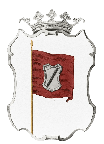
Initially, coats of arms were painted on the shields of warriors-knights, then images of coats of arms appeared on flags or banners of military units. Interesting information is provided by Jan Długosz, the author of the chronicle about the Battle of Grunwald. According to his chronicle, the army of the Grand Duchy of Lithuania-Rus consisted of 40 military units – banners, which included Lithuanians, Ruthenians (Eastern Slavs – residents of the Grand Duchy), Samogitians, and Tatars. Almost all banners had flags with similar images of “Pahonia,” only 10 of them had flags with the image of “Slupas” – the personal emblem of Vytautas. All flags-banners of Belarusian troops and districts had on one side the image of “Pahonia,” and on the other – an inscription or some image. The flags of the troops differed in the color of the fabric, but most were red, or rather, various shades of red. According to the “Lithuanian Metric,” the flag of the Vilnius voivodeship was red, the Volhynian – “brown,” the Polotsk – “sika,” the Novogrudok – “pale,” and the Minsk – “clove.” However, in the book by A. Gvanyin, compiled in 1578, all these flags are described as red. In addition to the aforementioned voivodeships, the Samogitian starostwo had a white flag, the Vitebsk and Kyiv voivodeships – green flags, but of different shades, the Brest and Trotsky – blue, and the Mstislav – yellow or, according to Gvanyin, orange. All flags of the voivodeships had two horns and differed, besides the color of the fabric, in the color of the knight and horse. There also existed a State flag – the State banner of the Grand Duchy, which represented a red rectangular fabric “sixty elbow” with four horns: on one side of the fabric was the image of Saint George – the State coat of arms “Pahonia,” on the other – the image of the Virgin Mary with the child Jesus in her arms against the background of the Sun. The Grand Hetman of the duchy also had his own flag: a blue fabric with the image of “Pahonia” on one side and Saint Stanislaus on the other. All flags were richly embroidered with plant ornamentation (in the 16th century) or animal (in the 17th century).
The Flag of Saint George
The production of such banners was a long and expensive affair, and they often perished during battles, so simple flags began to appear, consisting of colored stripes corresponding to the colors of the coat of arms or simple geometric shapes on a monochrome fabric. Thus, national and state flags of many countries emerged. For example, the coat of arms with images of Christian saints corresponded to flags with crosses of various shapes and colors. For instance, on the white fabric of the national flag of England, there is a red George’s cross, on the blue fabric of the national flag of Greece, a white George’s cross, on the blue fabric of the national flag of Scotland, a white cross of Saint Andrew, on the flag of the Russian Navy, on the white fabric, a blue cross of Saint Andrew, and on the green flag of the border troops of the Republic of Belarus, a red cross of Saint Andrew (by order of the Chairman of the State Committee of Border Troops of the Republic of Belarus from 20.03.2000 No. 98). There is information that the white flag with a red cross of Saint George was the personal standard of Grand Duke Vytautas. By the way, on the canvas depicting the Battle of Orsha in 1514 (the original is in Warsaw, and a copy is in Orsha, in the local history museum), the Belarusian army flies banners with the image of Saint George, and on the edges of the flag: in a white field, a red George’s cross: the vertical stripe divides the horizontal in a ratio of 1:2. Pennants with the same design were later carried on the flagpoles of military ships of the Russian Empire, whose crews were awarded George’s flags.
The state coats of arms of other countries, including Slavic ones, also harmonize very well with their flags and are laid out on their colors according to the rules of heraldry:
Poland: flag – white-red, coat of arms – silver eagle in a red field;
Czech Republic: flag – white-red, coat of arms – silver lion in a red field;
Slovakia: flag – white-blue-red, coat of arms – silver six-pointed cross on blue hills in a red field;
Slovenia: flag – white-blue-red, coat of arms – silver mountain Triglav in a blue field;
Serbia: flag – red-blue-white, coat of arms – in a red field silver cross and four crescents;
Croatia: flag – red-white-blue, coat of arms – red-silver “checkerboard”;
Yugoslavia: flag – blue-white-red, coat of arms – silver double-headed eagle in a red field, on its chest a shield with the national coats of arms of Serbia and Montenegro.
Thus, the national and state symbols of most Slavic states have either a white-blue-red or, like the national flags of Poland or the Czech Republic, a white-red combination of colors (by the way, white-red flags are also possessed by the lands of Austria: Tyrol and Upper Austria, while the flag of Lower Austria is blue-yellow, like the flag of Ukraine). The state flags of Slavic countries, in general, differ little from their national flags: for example, the state flags of Poland, Slovakia, Slovenia, and Croatia differ from the national flags only by the presence of the state coat of arms, while the state flag of the Czech Republic differs from the national one in that it has a blue triangle at the hoist – in memory of the united state with Slovakia. The green stripe on the flag of Bulgaria appeared in memory of the national liberation struggle, as the flags of the insurgents-haiduks were green, the color of the forests that concealed them. And the Russian flag most likely consisted of the colors of the coat of arms of the Grand Duchy of Moscow: on a silver horse, a knight in silver armor, over which is a blue cloak, in a red field kills a dragon with a spear. By the way, when our neighbors Lithuanians discussed in 1938 what their state symbols should be, the famous artist, a Belarusian by descent, Mstislav Dobuzhinsky, proposed to approve a white-red-yellow flag as the state flag, which would correspond to the colors of the coat of arms of the Lithuanian state: a silver knight in a red field with a red shield, on which is a golden cross. This was also the appearance of the State Coat of Arms of Lithuania adopted more than half a century later, although after the appeal of several members of the All-Russian Heraldic Society to the higher authorities of Lithuania, significant changes were made to it: the shield became blue, and the armor and the cape became blue.
Evolution of the Belarusian Flag
Thus, the common colors of the national symbols of most Slavic peoples are white and red. The roots of the symbolism of white-red colors date back to the second millennium BC. At that time, the Indo-European tribes, among whose descendants is the Belarusian people, occupied vast territories of Eurasia. In most of these tribes, white and red colors were revered. The white color – the color of maternal milk, which gives life – was associated with the nurturing earth, with mother-nature. The red color – the color of fire and blood – symbolized eternal life. Therefore, white and red colors were dominant both in everyday life (for example, white clothing with red embroidery) and in rituals (for example, during excavations of burials of that period, archaeologists find that the deceased were generously sprinkled with red paint – ochre). Later, the red color became the color of the supreme God of the Eastern Slavs, the God of Light – Dazhdbog or Kupala. The blue color – a symbol of the Creator of the Universe. In Christianity, blue symbolizes God – the Holy Spirit and Sophia, the Wisdom of God; white symbolizes the soul of the believer, and red – the fiery truth of the Word of God, which left its mark in this soul (hence in the clothing of Orthodox hierarchs, there is a white ribbon with a red stripe in the middle).
Slavic color symbolism had a decisive influence on the symbolism that emerged in the 13th century of the Grand Duchy of Lithuania-Rus and Samogitia, where Slavic genesis was predominant: the lands inhabited by Slavs comprised 9/10 of the territory of this state.
From about the 15th century in the Grand Duchy, according to the rules of Western European heraldry, which determined the order of laying out the coat of arms on the colors of the flag, two-colored flags began to appear. The image of a three-striped white-red-white flag is found on one of the engravings of “The Chronicle of All the World” by Polish historian M. Bielski, created in 1551. It is evident that this flag appeared later than the Polish white-red flag, as the colors of the field and figures of the coat of arms of the Grand Duchy and the Kingdom were the same, so when laying them out on the colors of the flag, the two-striped one was the one that appeared first.
However, there are also other accounts regarding the origin of the white-red-white flag.
The father of the well-known activist of the Belarusian association of Tatars-Muslims “Al-Kitab,” Y. Yakubowski, A. Yakubowski recalls that while serving in the Polish army in the 1930s, he heard the following story. Allegedly, at one time, well-known representatives of the Belarusian national revival, the brothers Lutkevich, found in one Al-Kitab (and among the ancestors of the brothers were Tatars, and Ivan Lutkevich had the ancient Al-Kitab in his personal library) information that part of the Tatars who participated in the Battle of Grunwald in 1410 fought under the direct command of Vytautas in the banner that had a white-red-white flag, on the red stripe of which were sewn a white crescent and a star (this flag became the official symbol of the Belarusian association of Tatars-Muslims “Al-Kitab” in 1990). Considering that the white-red-white flag was the personal flag of the popular Grand Duke Vytautas in Belarus, the brothers began to promote the white-red-white flag as the historical flag of Belarusians.
Unfortunately, they could not find that Al-Kitab that would confirm the hypothesis of the Lutkevich brothers, but at their suggestion, the white-red-white flag gained popularity in various circles of the national movement, and even a legend about the origin of the white-red-white flag emerged. It tells that once in a fierce battle with the knights-crusaders, a prince who was at the head of the squad was mortally wounded; an enemy sword cut his head. The warriors carried the prince from the battle and bandaged his wounded head with a white cloth ribbon. But the squad, left without its prince, could not withstand the pressure of the enemy and began to retreat. Then the wounded prince gathered all his strength, rose, tore off the bandage from his head, unfurled it as a flag, and went into the thick of battle. Seeing this, the Belarusian warriors attacked the enemy and defeated him completely. And the white fabric with a red stripe in the middle became a symbol of courage and bravery.
After the Union of Lublin in 1569, which united both states into the Commonwealth, attempts were made to create the flag of this state by combining the colors of the coats of arms of the Grand Duchy and the Kingdom. Thus, Władysław IV used a red-white-red state flag of the Commonwealth, which fully corresponded to the colors of the coats of arms of the kingdom and the Grand Duchy, the combination of which constituted the state coat of arms of the Commonwealth. On the canvas depicting the wedding procession of Sigismund III Vasa and Queen Constance in Kraków in 1605, there is an image of the flag that King Sigismund used as a state flag, consisting of three horizontal stripes of equal width: red, white, and red; in the center of the canvas was the state coat of arms of the Commonwealth. From 1609 to 1916, a similar but four-striped flag was used as the state flag: white-red-white-red. A similar flag is located in the royal museum in Stockholm. At the turn of the 17th and 18th centuries, there were attempts to establish a red-white flag as the state flag of the Grand Duchy.
Flag of the Insurgents of 1831
After the three partitions of the Commonwealth, practically all the territory of present-day Belarus found itself within the Russian Empire. During this period, even the use of the name Belarus was prohibited, not to mention the possibility of using the national flag, although elements of national symbolism were used for some time, until the uprising of 1863, in the symbolism of military units of the Russian army formed from the inhabitants of Belarus.
Perhaps the question of what the Belarusian national flag should be arose during the congress of Belarusian national organizations held in Minsk from March 25 to 27, 1917. Unfortunately, no documents have survived, but there are memories of participants of those events, recorded a few years later. Thus, one of the figures of the Belarusian national movement, K. Duzh-Dusheyski, in his memoirs written in the 1930s recalls that when the question arose about what the state flag should be, he made several project sketches of it, from which the project of the white-red-white flag was approved. Unfortunately, the exact date of this event is not mentioned. But it is possible that K. Duzh-Dusheyski made a drawing of the already existing white-red-white flag. The following facts speak in favor of the fact that the white-red-white flag existed before the congress:
– in 1863, an uprising broke out on the territory of the former Commonwealth. Initially, the insurgents acted under the Polish white-red flag, but there are indirect testimonies that K. Kalinowski also used the white-red-white flag. For example, in 1870, the student fraternity of young Latvians, discussing what the national flag should be, considered the project of the white-red-white flag, but it is possible that among them was a participant or witness of the uprising K. Kalinowski, so the project of the white-red-white flag was rejected because “in such a combination it coincided with the flag of Belarusians”;
– there are also reports that the white-red-white flag was used at the end of the 19th century by Petersburg students-Lithuanians (Belarusians) during cultural and educational evenings. Y. Kupala recalls participating in one of them;
– in 1916, in Petersburg, the Belarusian committee for assistance to those affected by the war displayed the white-red-white flag on its building;
– during the “Day of the Belarusian Badge” held in Minsk on March 12, 1917, badges of white-red-white colors were distributed.
However, in the memories of other figures of the national movement, there are reports that at the opening of the congress on March 25, a white flag was displayed, which was supposed to symbolize White Russia, but this flag caused unanimous objections from the deputies, as the white flag had established itself as a flag of capitulation. Then, at the meeting of the newly formed Belarusian National Committee, the issue of symbolism was considered, where the project proposed by Duzh-Dusheyski was approved. A decision was also made to produce flags and distribute them to all local organizations. According to the memories of R. Astrovski, it was this white-red flag, on the fabric of which was embroidered in gold letters “Long live free Belarus!”, that he personally received in April 1917 in Slutsk, where he was working at that time. In the newspapers published at that time, there are also reports of the existence of the white-red-white flag, and in several variations: a flag without inscriptions or images; a flag with sewn or embroidered mottos; a flag, on one side of which was the image of “Pahonia” in the rays of the rising sun. The symbolism of the flag’s colors was explained as follows: the white color symbolizes the name of the country and reminds that Belarus was a free, independent state when the rest of the East Slavic lands were under the Mongol-Tatar yoke; red symbolizes the national revolution and the rising sun as a symbol of national revival and liberation.
This flag gained popular recognition. Thus, in the Statute of the Belarusian national cultural and educational groups in the army, which was adopted on July 5, 1917, at the First Session of the Central Council of Belarusian Organizations, it was recorded: “Every member of the Belarusian community in the army must wear the Belarusian national sign – a white ribbon with a red stripe in the middle; all three stripes – white, red, and white – of equal width” (Turuk F. The Belarusian Movement. M., 1921, Appendix No. 11, p. 91).
Flag of the BNR
Although during the Bolshevik rule the white-red-white flag was banned, it was not forgotten. According to some reports, it was displayed on the building where the People’s Secretariat was previously located as early as February 19, 1918, as soon as the Bolsheviks evacuated from Minsk, but the flag was torn down by the Germans, who soon entered the city.
After the declaration of the Belarusian People’s Republic and its independence from Russia, the white-red-white flag and the coat of arms “Pahonia” began to be used as state symbols of the young republic. The flag was officially approved by the Secretariat of the BNR on July 5, 1918, about which the newspaper “Free Belarus” reported on July 11.
After the formation of the USSR on December 30, 1922, a policy of developing national culture began to be implemented in Belarus. For example, business was conducted in the Belarusian language, teaching was conducted in universities, it was studied in military units, and even military statutes were published in the Belarusian language, and a dictionary of military terminology was developed. In the framework of this policy, in 1926, an attempt was made to adopt the Belarusian national flag as the state flag of the republic. This proposal was made by the chairman of the Central Executive Committee of the BSSR, Y.A. Adamovich. However, he was soon repressed, and no one dared to make such proposals again.
In the BSSR, the white-red-white flag and “Pahonia” were banned, while in Western Belarus, which was ceded to Poland by the Riga Peace Treaty of 1921, the national Belarusian symbols continued to be used by the Belarusian population. Thus, the cockades of students of the Vilnius gymnasium had white-red-white stripes, national symbols were placed in Belarusian reading rooms and clubs, and even the Red Army was met on September 17, 1939, not only with red flags but also with white-red-white ones.
During the Great Patriotic War, the German occupation authorities, in order to attract Belarusians who suffered from Bolshevik repressions, allowed limited use of Belarusian national symbolism. This is evidenced by a publication on September 6, 1942, in the Belarusian newspaper “Ranitsa” (published in Berlin), which stated that on July 27, 1942, the general commissioner V. Kube issued a special order allowing the use of the white-red-white flag and “Pahonia” during celebrations. The permission to use national symbols essentially meant recognition of the right of Belarusians to form their own autonomous state within the German Reich, but the Hitler leadership had completely different intentions regarding Belarus.
In the late 1980s, with the rise of the national movement, the white-red-white flag was revived again. For the first time, several white-red-white flags were raised by supporters of the Belarusian Popular Front on October 30, 1988, in Minsk during the celebration of “Dziady,” after which police units were thrown against the participants of the action. However, at the rally on February 19, 1989, when several thousand workers from Minsk factories gathered in the current Independence Square of the Belarusian capital, a sea of white-red-white flags fluttered over the sea of people.
Between September 17 and 23, 1989, the Presidium of the Minsk City Council of People’s Deputies adopted a resolution “On Belarusian National Symbolism and Its Use in Minsk,” according to which all organizations, state and public institutions, and residents were granted the right to simultaneously use the national Belarusian symbolism alongside the State symbols of the BSSR. Additionally, at the meeting of the city council, there was a proposal to raise the Belarusian national flag over the city council building, but it lacked one vote for its adoption.
Dziady-1988
On July 27, 1990, the Belarusian SSR declared its sovereignty, and on June 25, 1991, Belarus became an independent country. The issue of state symbolism was included in the agenda of the Sixth Extraordinary Session of the Supreme Council of the Republic. When this became known, the opposition deputies, most of whom were members of the Belarusian Popular Front “Revival,” launched explanatory and agitation work among the deputies of the Supreme Council to promote Belarusian national symbols: the white-red-white flag and the coat of arms “Pahonia.” This work, along with the “round tables” on national symbolism held in the late 1980s and the appeal of employees of the Institute of History of the Academy of Sciences of the Republic to the deputies of the Supreme Council, bore fruit, and on September 19, 1991, the Supreme Council of the country adopted the Law on the State Flag of the Republic of Belarus, which stated: “The State Flag of the Republic of Belarus represents a fabric consisting of three horizontally arranged colored stripes of equal width: the upper and lower are white, and the middle is red. The ratio of the width of the flag to its length is 1:2.”
On December 10, 1991, by the resolution of the Supreme Council of the Republic of Belarus, the Provision on the State Flag of the Republic of Belarus was approved, which also provided a description of the flag and established the procedure for its use.
Comparing all Slavic flags, it can be noted that not all possible combinations of white, blue, and red colors have been used. In fact:
white-blue-red flags of Russia, Slovakia, and Slovenia;
blue-white-red – of Yugoslavia;
red-white-blue – of Croatia;
red-blue-white – of Serbia and Montenegro;
only the combinations of white-red-blue and blue-red-white remain unused. Moreover, both of these combinations differ from the well-known national Belarusian flag by only one blue stripe, which does not disrupt its main design. Historical sources indicate that there were attempts to place blue on the white-red-white flag, which would make it similar to the flags of other Slavic peoples. For example:
in 1917, at the First All-Belarusian Congress, a project of a red-white-blue flag was proposed as the State flag of Belarus (which is now the State flag of Croatia), but for some reason, this project was not approved;
in a black-and-white photograph from the period of 1919-1925, when the government of the BNR was in exile in Vilnius, the central stripe, undoubtedly white-red-white, of the State flag of the BNR has a border of narrow stripes of a darker color, approximately 1/16 the width of the flag itself. It was suggested that the color of these stripes was black – in mourning for the Motherland, where Bolshevik rule had been established. But it is more plausible that the stripes were blue. Then the description of the coat of arms organically combines with the description of the flag, emphasizing their interconnection: on a silver horse, a silver knight with a raised sword and a blue shield jumps in a red field, on the blue shield – a silver double cross; thus, the colors of the flag: white, blue, red, blue, white. The knight’s shield of “Pahonia” would be blue, and when laying out the coat of arms on the colors of the flag, the flag should be three-striped, like the flags of other Slavic peoples, therefore, to avoid repeating the Slavic flags with white, red, and blue horizontal stripes of various combinations, blue stripes were placed between the red and white stripes.
It is precisely based on the fact that the colors of the national coat of arms are white, red, and blue that the project of the flag of the Belarusian association of military personnel, reserve servicemen, retirees, and other citizens, which is better known as BZV, was developed. The flag represents a white-red-white fabric, with a blue equilateral triangle (the length of its sides equal to the width of the flag) at the hoist, in which is a white double cross. The flag was approved by the decision of the Coordination Council of the Patriotic Movement on April 13, 1997, protocol No. 5.
Thus, the use of white, red, and blue colors in Belarusian symbolism is fully justified based on the historical traditions of our people. Unfortunately, the historical experience of heraldry and vexillology was not required either during the creation of State symbols in 1991 or during the creation of State symbols in 1995.
“Our Word,” No. 19(507), 09.05.2001.